
When people hear the words “Chinese tea ceremony,” they may imagine a quiet room, beautiful teaware, carefully measured tea leaves, and someone performing every step with perfect precision.
It can look very formal from the outside.
But here is a little secret: Chinese tea doesn’t always need a ceremony.
You can enjoy it just as naturally as sitting down with a friend and having a chat.
Tea Ceremony Has Never Had Just One Form
Chinese tea culture has a long history, but it has never been limited to one fixed way of drinking tea.
During the Tang Dynasty, tea was commonly prepared by boiling the tea. In the Song Dynasty, whisked tea became popular. By the Ming Dynasty, brewing loose tea with hot water had become increasingly common.
The methods changed with time, but something remained surprisingly consistent: tea was closely connected with cultivating the mind and welcoming others.
In other words, tea was never only about the drink.
It was also about how we spend time with ourselves and how we treat the people sitting across the table.
So, What Makes a Tea Ceremony Different?
The biggest difference is probably the intention and setting, rather than a strict list of rules.
A formal tea ceremony may pay close attention to the tea ware, movements, brewing steps, and atmosphere.
Everyday tea drinking can be much simpler.
You might put some tea leaves into a cup, add hot water, wait a little, and start drinking while answering emails.
Or perhaps you make a pot of tea and sit down with a friend for an hour without checking your phone.
Both can be part of Chinese tea culture.
And honestly, I think that is what makes tea so lovely.
You Can Feel It in a Tea House
If you visit a traditional Chinese tea house, you may understand this better than any book could explain.
You walk through the door, and you are a guest.
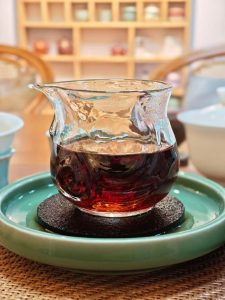
Someone may quietly bring you a warm cup of tea: something to warm your stomach, settle you down, and help you slow your pace.
Every tea house owner has their own personality, of course.
One might greet you with a cheerful:
“You’re here! Come in, sit down.”
Another might smile and say:
“Good afternoon. What would you like to drink today?”
Neither needs to be particularly formal.
The tea is simply a natural way of welcoming you.
What About Serenitea?
That is also how I hope Serenitea Tea House feels.
If you want to chat, I am happy to sit with you and talk about tea, photography, travel, life, whatever happens to come up.
If you would rather have some quiet time, that is perfectly fine too.
You can simply sit at the tea table, watch the steam rise from your cup, and let your mind wander for a while.
Maybe we talk.
Maybe we don’t.
There is no ceremony you need to perform.
There is only tea, a little time, and whoever happens to be sitting at the table with you.
Tea Doesn’t Have to Be Complicated
Perhaps this is the simplest way to understand the difference between Chinese tea ceremony and everyday tea drinking:
A tea ceremony gives tea a deliberate setting. Everyday tea gives tea a place in life.
And sometimes, the two become the same thing.
A carefully prepared cup of tea shared with a guest can be a ceremony.
So can an ordinary afternoon when you make yourself a pot of tea, put your phone away, and finally take a proper breath.
You don’t need to know every tea rule to enjoy Chinese tea.
Just come in, sit down, and have a cup.
The tea will take care of the rest.
If you’re curious about the story behind Serenitea Tea House — why I started it and what I hope tea can bring to everyday life, you can read: https://tealuz.com/why-i-started-serenitea/
