
If you have ever tried Chinese tea and compared it with a traditional British or Western-style cup of tea, you may have noticed something interesting.
They are both made from the same plant, Camellia sinensis, but the experience can feel completely different.
So what is the difference between Chinese tea and Western tea?
In one sentence:
Chinese tea traditionally focuses on the flavor of the tea itself, while Western tea traditions often focus on creating a good-tasting drink.
Neither approach is better. They simply developed around different ideas of what a cup of tea should be.
One invites you to slow down and notice the tea. The other often makes tea part of a larger drinking experience — with milk, sugar, lemon, herbs, food, or other ingredients.
And once you understand this difference, many things about Chinese tea suddenly become easier to understand.
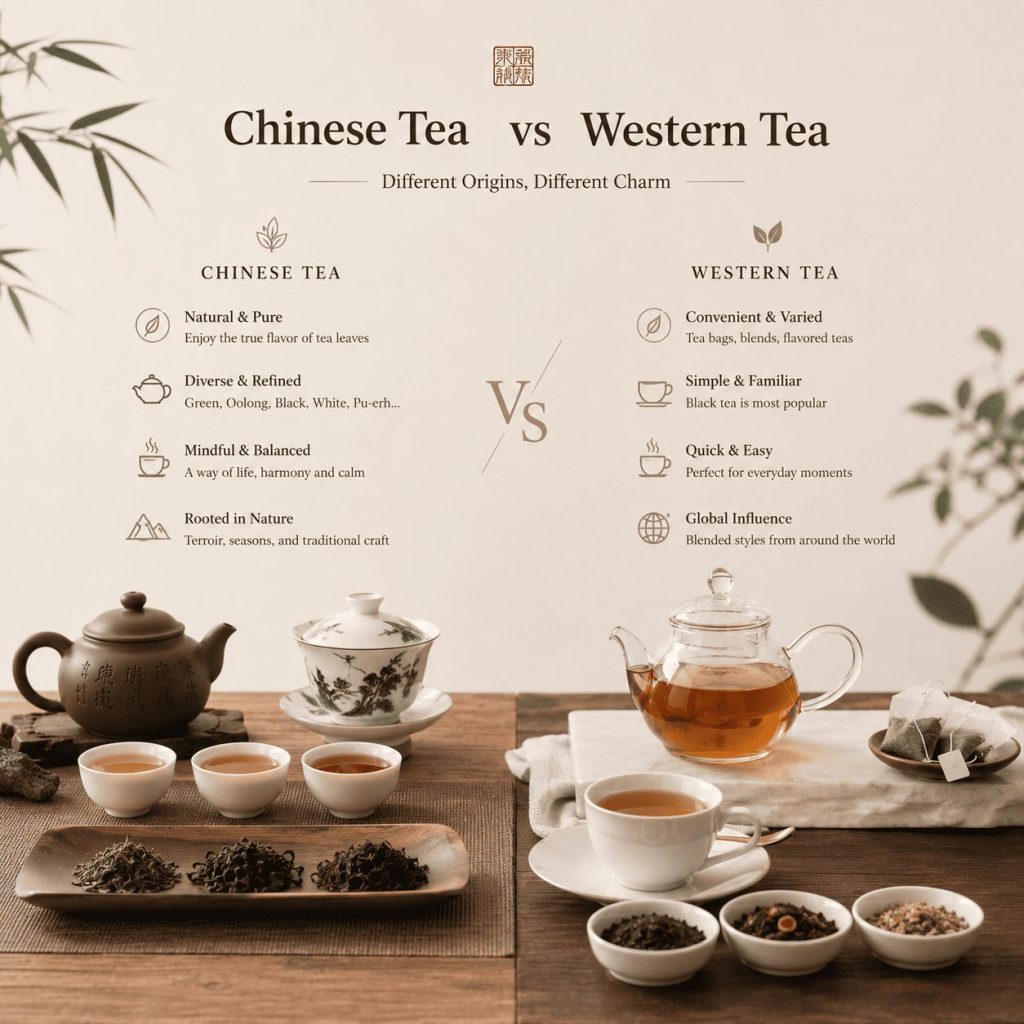
Tea Leaf vs. Blending: Where the Difference Begins
One of the biggest differences is what happens to the tea leaves before they reach your cup.
Traditional Chinese tea culture has a strong appreciation for the character of the original leaf.
A tea can be connected to a particular mountain, village, garden, season, cultivar, or even a particular harvest. The idea is that these details can influence what eventually appears in your cup.
This is somewhat similar to the idea of terroir in wine.
A grape grown on one hillside may taste different from the same variety grown somewhere else. Soil, climate, altitude, rainfall, sunlight, and cultivation methods all contribute to the character of the wine.
The same idea can be found in Chinese tea.
A Wuyi Rock Tea from one part of Wuyi Mountain may have a different aroma and texture from another tea grown only a short distance away. An Anxi Tieguanyin from one season may also taste slightly different from another harvest.
That difference is not necessarily a problem to be corrected.
It is part of the character of the tea.
For many Chinese tea drinkers, discovering these small differences is part of the fun.
Western tea traditions, on the other hand, have historically placed more emphasis on consistency and blending, especially in commercially produced tea.
A tea company may combine teas from different regions or even different countries to create a particular flavor profile. The purpose is often to make sure that a familiar tea tastes familiar from one box to the next.
This makes perfect sense.
If you drink a breakfast tea every morning, you probably want it to taste like the breakfast tea you enjoyed last week.
So we could think of the two approaches like this:
Chinese tea often asks:
“What does this tea taste like?”
Blended Western tea often asks:
“How can we create a cup that tastes consistently good?”
Again, neither is inherently better.
They are simply answering different questions.
Chinese Tea and the Idea of Terroir
This is one of the most fascinating parts of Chinese tea culture.
Tea lovers may talk about where a tea comes from almost as much as what type of tea it is.
Is it from Wuyi Mountain?
Anxi?
Fenghuang?
Yunnan?
A high mountain garden?
A particular village?
The reason is simple: place matters.
The environment in which tea grows can influence its character. Temperature, altitude, sunlight, rainfall, soil, surrounding vegetation, and farming practices can all play a role.
For Wuyi Rock Tea, for example, the rocky mountain environment is an important part of its identity.
The tea is not simply “oolong tea.”
It is Wuyi Rock Tea.
And within Wuyi Rock Tea, there are different cultivars and styles, such as Rougui and Shui Xian, each with its own personality.
This is why Chinese tea can sometimes feel surprisingly similar to wine.
You don’t necessarily drink a bottle of wine only because it is “red wine.”
You may want to know the grape, the region, the producer, the vintage, and the style.
Chinese tea can be approached in much the same way.
You can simply drink it, of course.
But if you become curious, there is always another layer to discover.
Processing Matters More Than You Might Expect
Another important difference is the attention Chinese tea culture gives to processing.
Tea leaves are not simply picked and dried.
Depending on the type of tea, they may go through withering, rolling, oxidation, roasting, shaping, drying, or other processing steps.
Small differences in processing can produce surprisingly different flavors.
Take oolong tea as an example.
A lightly processed or lightly roasted oolong may have a fresh, floral, almost spring-like character.
Another oolong can receive a heavier roast and develop deeper notes of toast, nuts, dried fruit, caramel, or wood.
The leaf may come from a similar region, but the final cup can feel completely different.
This is one reason Chinese tea can be so interesting to explore.
The raw material matters, but what you do with it matters too.
Western tea production also pays close attention to processing, of course. But large-scale commercial tea production often places greater emphasis on achieving a consistent level of oxidation, color, strength, and flavor.
Here, it is worth making one small clarification.
People often call the process “fermentation,” but technically, most traditional black and oolong teas undergo oxidation, rather than microbial fermentation.
The degree of oxidation is an important part of the tea’s final character.
In traditional Chinese tea making, however, oxidation is only one part of a much larger processing tradition.
A Cup of Tea Can Change From One Brew to the Next
This is perhaps the biggest difference you will notice when actually drinking Chinese tea.
Chinese tea is often enjoyed without milk or sugar.
The leaves themselves are expected to provide the flavor.
And rather than making one large pot and drinking it over a long period, many Chinese tea traditions use a relatively small amount of water and brew the same leaves several times.
This is especially common in Gongfu-style tea brewing.
The first infusion might be light and aromatic.
The second may become fuller.
The third might reveal more sweetness.
Later infusions can become softer, deeper, or more mineral-like.
The tea changes as you drink it.
This creates a different kind of drinking experience.
Instead of asking:
“Do I like this tea?”
you may gradually start asking:
“What is the tea doing now?”
You notice the aroma before drinking.
Then the texture.
Then the sweetness.
Then the aftertaste.
Then what remains in your mouth after the tea is gone.
It becomes less about getting one perfect cup and more about watching the tea unfold.
Why Western Tea Often Loves Milk, Sugar, and Blending
Now compare that with a traditional Western tea experience.
Think of a strong breakfast tea with milk.
The tea needs enough body and strength to work with the milk. Sugar may add sweetness. Perhaps there is toast, biscuits, cake, or breakfast alongside it.
The tea is not necessarily expected to stand alone.
It becomes part of a larger moment.
This is also why blending makes so much sense in Western tea culture.
A blend can be designed to provide a specific balance of strength, color, aroma, and body.
Add milk, and the cup becomes creamy.
Add sugar, and it becomes sweeter.
Add lemon, and the character changes again.
In this style of tea drinking, the final cup can almost be thought of as a recipe.
The tea is one important ingredient, but it does not have to be the only one.
And honestly, there is something wonderful about that too.
A strong cup of tea with milk on a cold morning is a completely different pleasure from slowly tasting a delicate oolong in a small Chinese teacup.
You don’t have to choose one.
Two Different Ways of Enjoying Tea
Perhaps the simplest way to understand the difference is to imagine two tea tables.
At one table, someone pours a small cup of Wuyi Rock Tea.
They smell the dry leaves.
They pour hot water over them.
They take a sip.
They pause.
“That’s interesting. I didn’t notice that aroma in the first infusion.”
Another infusion is poured.
They taste again.
Maybe the tea has become sweeter.
Maybe the roasted character is stronger.
Maybe the finish lasts longer.
The tea itself is the center of attention.
At another table, someone pours a strong black tea into a large mug.
They add a little milk and sugar.
They sit down with breakfast and start their day.
The tea doesn’t need to demand attention.
It simply makes the morning better.
Both are perfectly good ways to drink tea.
And perhaps this is the most important thing to remember.
Chinese tea culture is not about being more sophisticated.
Western tea culture is not about being less sophisticated.
They simply developed different relationships with the same plant.
From “Drinking Tea” to “Tasting Tea”
For someone who is new to Chinese tea, this difference can feel intimidating at first.
You might see people talking about aroma, body, mouthfeel, aftertaste, roast, mineral character, floral notes, and Yan Yun — “rock charm.”
It can sound like you need a dictionary before you are allowed to drink the tea.
You don’t.
You can simply drink it.
You don’t need to know the name of every aroma.
You don’t need to identify whether you are tasting orchid, orchid-like flowers, roasted nuts, dried fruit, or something else.
If a tea smells good to you, enjoy it.
If it makes you slow down for a few minutes, that’s enough.
The vocabulary can come later, if you become curious.
This is one of the things I love about Chinese tea.
You can enjoy it without understanding it, and understand it more as you enjoy it.
So, Which One Is Better?
There really isn’t an answer.
Chinese tea traditions often celebrate the original leaf, its place, its processing, and the changes that happen from one infusion to another.
Western tea traditions often celebrate consistency, balance, strength, and the pleasure of creating a satisfying drink.
One tends to put more attention on the tea itself.
The other often puts more attention on the finished cup.
And perhaps that is why tea has travelled so successfully across cultures.
It can be whatever you need it to be.
A carefully brewed Wuyi Rock Tea can give you ten quiet minutes in the middle of a busy afternoon.
A strong cup of black tea with milk can make a cold morning feel a little warmer.
You can taste the tea carefully.
Or you can drink it while reading a book.
You can discuss terroir and processing.
Or you can simply say:
“This is really good.”
There is no wrong way to enjoy tea.
At the end of the day, Chinese tea and Western tea are not two competing ways of drinking tea. They are two different ways of finding a good moment in a cup.
Why Did I Start Serenitea Tea House?
If you’re curious about why I started Serenitea Tea House and what I hope to share through Chinese tea, you can read https://tealuz.com/serenitea-tea-house/
For me, tea has never been only about learning the “right” way to drink it. It’s also about having a good cup of tea on an ordinary afternoon, slowing down for a while, and sometimes simply sitting quietly with yourself.
